

“Should I rent or buy a home?” is one of the most searched personal finance and real estate questions in 2026. Rising property prices, fluctuating interest rates, remote work culture, and economic uncertainty have changed how people think about homeownership.
For decades, buying a house was considered the ultimate financial goal. Today, many financially smart individuals are choosing to rent instead of buying – especially in expensive cities where property prices are increasing faster than incomes.
At the same time, real estate remains one of the most trusted long-term wealth-building assets globally. Homeowners benefit from appreciation, tax advantages, leverage, and stability.
So, which option is better in 2026: renting or buying?
The answer depends on your income, location, lifestyle, financial goals, and investment strategy.
This detailed guide compares renting vs buying a home using real-world financial examples, market trends, tax implications, investment returns, and lifestyle factors to help you make the right decision
Why Renting vs Buying a Home: Quick Comparison
| Factor | Renting | Buying |
|---|---|---|
| Upfront Cost | Low | High |
| Monthly Flexibility | High | Moderate |
| Long-Term Wealth Creation | Limited | Strong Potential |
| Maintenance Responsibility | Landlord | Owner |
| Tax Benefits | Minimal | Available |
| Stability | Lower | Higher |
| Mobility | Easy to Relocate | Harder to Move |
| EMI/Rent Predictability | Rent can increase. | Fixed EMI Possible |
| Asset Ownership | No | Yes |
| Best For | Short-term living | Long-term settlement |
Why the Renting vs Buying Debate Is Trending
Several economic and lifestyle changes have made this topic more important than ever:
- Property prices in major cities continue to rise
- Home loan interest rates remain volatile
- Younger generations prioritize flexibility
- Remote work allows people to relocate easily
- Rental markets are becoming more competitive
- Real estate is increasingly viewed as an investment asset
What Renting Really Means in 2026
Renting a home means paying a landlord monthly to use a property without owning it.
While previous generations viewed renting as “wasted money,” modern financial experts often see renting as a strategic financial choice.
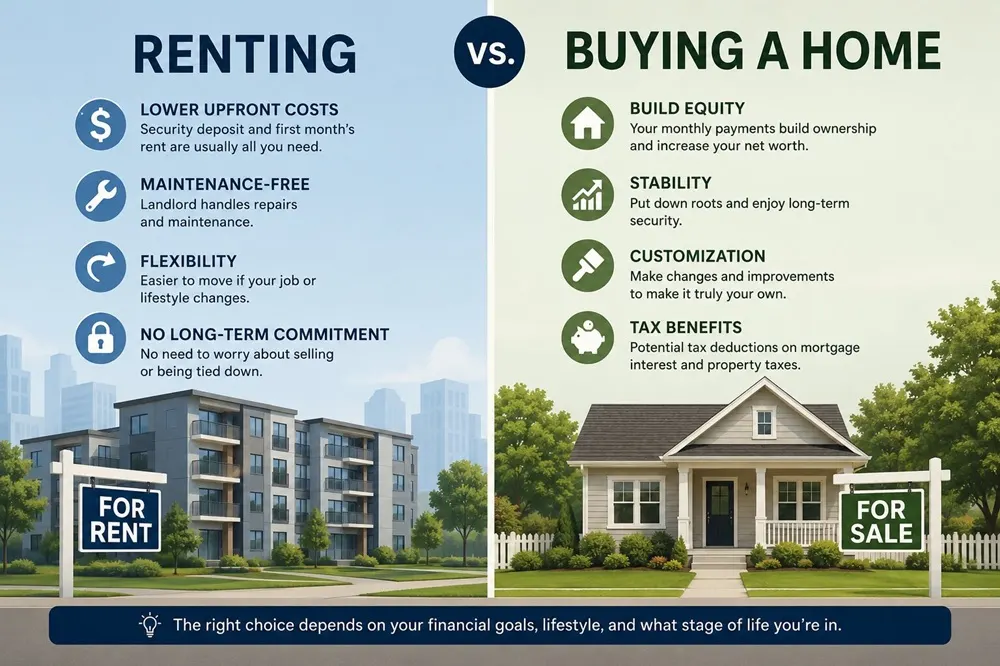
Advantages of Renting
1. Lower Initial Costs
Renting usually requires:
- Security deposit
- Advance rent
- Brokerage fees
Buying requires:
- Down payment
- Registration charges
- GST/stamp duty
- Loan processing fees
- Interior setup costs
In many cities, buying a home may require 15–25 times more upfront capital than renting.
2. Higher Financial Flexibility
Renters can:
- Relocate easily
- Upgrade or downgrade homes quickly
- Avoid long-term debt commitments
- Invest savings elsewhere
This flexibility is valuable for:
- Young professionals
- Remote workers
- Start-up founders
- Frequent travelers
3. No Maintenance Burden
Major repair costs are usually paid by landlords, including:
- Structural repairs
- Plumbing issues
- Electrical failures
- Water leakage problems
Homeowners pay these costs themselves.
4. Better Cash Flow Management
In many cities, rent is significantly lower than home loan EMI.
Example:
- Monthly Rent: ₹35,000
- Home EMI for Same Property: ₹75,000
The remaining ₹40,000 can potentially be invested into:
- Mutual funds
- Stocks
- Retirement funds
- Business opportunities
India Housing Market Statistics (2025–2026)
| Housing Statistics | Latest India Data |
|---|---|
| RBI Repo Rate (2025) | Reduced by 100 basis points improving affordability |
| Mumbai Home Affordability Ratio | Improved from 50% to 48% |
| Pune Affordability Ratio | Around 22% |
| Ahmedabad Affordability Ratio | Around 18% (most affordable major city) |
| Expected Urban Rent Increase | 5%–8% annually |
| Expected Home Price Growth | 5%–7% annually in major cities |
| Affordable Housing Shortage | ~10 million homes deficit |
| Luxury Housing Share (2025) | 63% of total residential sales |
| Typical Rental Yield in Tier-1 Cities | Around 2%–3% |
| Common Home Loan Interest Rate | Around 7.5%–9% |
Sources: Knight Frank India, Reserve Bank of India (RBI), National Housing Bank (NHB), Reuters reports.
What are the disadvantages of Renting
1. No Asset Ownership
Rent payments do not build ownership or equity.
After 20 years of renting:
- You still do not own the property
- Rent continues indefinitely
2. Rent Inflation
Rental prices often increase every year.
In high-demand areas:
- Annual rent hikes may reach 5–12%
- Long-term affordability becomes difficult
3. Limited Customization
Renters usually cannot:
- Renovate freely
- Modify interiors permanently
- Create long-term emotional ownership
4. Uncertainty
Landlords may:
- Increase rent suddenly
- Ask tenants to vacate
- Sell the property unexpectedly
What Buying a Home Means in 2026
Buying a home means acquiring ownership through full payment or mortgage financing.
Homeownership remains emotionally and financially important because it offers:
- Stability
- Wealth creation
- Security
- Long-term appreciation potential
What are the advantages of Buying a home?
1. Building Long-Term Wealth
Every EMI payment gradually increases your ownership stake.
Unlike rent:
- EMIs build equity
- Property values may appreciate
- The home becomes an asset
Historically, real estate has appreciated steadily in most urban markets over long periods
2. Property Appreciation Potential
Real estate values may increase due to:
- Infrastructure development
- Metro connectivity
- IT growth corridors
- Economic expansion
For example:
Properties near new metro stations often experience significant appreciation over time.
3. Tax Benefits
Homebuyers may receive tax deductions on:
- Principal repayment
- Interest payment
- First-time buyer schemes
These benefits can reduce effective ownership costs.
4. Stability and Security
Homeownership provides:
- Predictable housing costs
- Emotional satisfaction
- Long-term family security
Families with children often prioritize stability over mobility.
5. Inflation Protection
As rents increase over time:
- Fixed EMI loans become relatively cheaper
- Property value may rise with inflation
This creates a long-term financial advantage.
Renting vs Buying Example (Bangalore 2026)
| Example Scenario | Renting | Buying |
|---|---|---|
| Property Value | ₹1.2 Crore | ₹1.2 Crore |
| Monthly Rent | ₹30,000 – ₹45,000 | EMI ₹85,000 – ₹1,00,000 |
| Down Payment | ₹0 – ₹2 lakh deposit | ₹20 – ₹30 lakh upfront |
| Stamp Duty & Registration | Minimal | ₹7 – ₹10 lakh in Karnataka |
| 10-Year Financial Flexibility | Higher | Lower |
| Long-Term Asset Ownership | No | Yes |
What are the disadvantages of Buying a Home
1. High Upfront Costs
Buying a property includes:
- Down payment
- Stamp duty
- Registration charges
- GST
- Brokerage
- Interior furnishing
- Maintenance deposits
These costs can add 10–20% above property value.
2. Long-Term Debt Commitment
Most home loans last:
- 15 years
- 20 years
- 30 years
This reduces:
- Financial flexibility
- Career mobility
- Risk-taking ability
3. Maintenance Costs
Homeowners must pay for:
- Repairs
- Society maintenance
- Property taxes
- Renovations
- Insurance
These costs increase over time.
4. Market Risk
Property prices do not always rise.
Factors affecting real estate markets:
- Economic slowdown
- Oversupply
- Interest rate hikes
- Infrastructure delays
Buying at the wrong time may reduce returns.
Renting vs Buying: Financial ComparisonExample
Let’s compare renting vs buying using a practical example.
Scenario
Property Value: ₹1 Crore
Down Payment: ₹20 Lakh
Loan Amount: ₹80 Lakh
Interest Rate: 8.5%
Loan Tenure: 20 Years
Buying Cost
Approximate EMI:
EMI≈₹69,000
Additional yearly costs:
- Maintenance
- Property tax
- Insurance
- Repairs
Renting Cost
Monthly Rent:
Rent≈₹30,000
Potential monthly investment savings:
Savings = ₹69,000−₹30,000 = ₹39,000
If invested wisely over 20 years, these savings may generate substantial wealth.
When Renting Makes More Sense
Renting may be the smarter option if:
You Should Rent If:
- You may relocate within 3–5 years
- Your job location is uncertain
- Property prices are overvalued
- Your income is unstable
- You want investment flexibility
- You prefer lower financial stress
- You are building a business or startup
When Buying Makes More Sense
Buying may be better if:
You Should Buy If:
- You plan to stay long-term
- You have stable income
- You can afford the down payment comfortably
- EMI is manageable
- You value stability
- You want to build long-term wealth
- You are purchasing in a high-growth area
| Scenario | Rent | Buy |
|---|---|---|
| Staying < 5 years | ✅ | ❌ |
| Frequent job changes | ✅ | ❌ |
| Stable long-term residence | ❌ | ✅ |
| High property appreciation area | ❌ | ✅ |
| Need flexibility | ✅ | ❌ |
| Wealth creation goal | ❌ | ✅ |
Renting vs Buying: Investment Perspective
Many financially aware individuals now compare:
Option A:
Buy property using leverage
vs
Option B:
Rent affordably and invest aggressively
This strategy is commonly called the following:
“Rent and Invest”
The idea is simple:
- Rent a cheaper home
- Invest the difference in higher-return assets
In some cases, diversified investments outperform real estate appreciation.
However, real estate also offers:
- Leverage benefits
- Tangible ownership
- Emotional security
- Forced savings discipline
What are the hidden costs of buying a home?
Many first-time buyers focus only on EMI.
But actual ownership costs include:
- Registration
- Legal fees
- Maintenance
- Parking charges
- Clubhouse fees
- Repairs
- Furnishing
- Home insurance
These hidden costs significantly increase the true purchase price.
Emotional Factors in Renting vs Buying
Financial calculations matter, but emotions also influence decisions.
Emotional Benefits of Buying
- Sense of achievement
- Family stability
- Social status
- Freedom to customize
Emotional Benefits of Renting
- Freedom
- Lower stress
- Flexibility
- Minimal long-term obligation
The best decision balances the following:
- Financial health
- Lifestyle goals
- Mental comfort
Compare Renting vs Buying in Major Cities
In expensive cities:
- Renting is often cheaper monthly
- Buying requires massive capital
In developing suburbs:
- Buying may provide better appreciation potential
The decision varies significantly by location.
Is Renting Better Than Buying in 2026?
There is no universal answer.
Renting Is Better When:
- Flexibility matters more
- Property markets are overheated
- You want investment liquidity
- You may relocate frequently
Buying Is Better When:
- You want long-term security
- You can comfortably afford ownership
- You are financially stable
- The property has appreciation potential
Expert View: The Smartest Approach
Financial experts increasingly recommend this approach:
Buy a Home Only If:
- EMI is affordable
- Emergency savings exist
- You plan to stay long-term
- You still have investment capacity after EMI
Buying a house should not destroy:
- Cash flow
- Lifestyle quality
- Retirement planning
What are the common mistakes, People Make when Buying or Renting Homes:
1. Buying Because of Social Pressure
Many buyers purchase homes too early because:
- Family expectations
- Social comparison
- Fear of missing out
2. Ignoring Total Ownership Cost
EMI is only one part of ownership expenses.
3. Renting Without Investing Savings
If renters spend all savings instead of investing:
- Renting loses financial advantage
4. Buying Beyond Budget
High EMIs can damage:
- Mental health
- Savings ability
- Financial freedom
Renting vs Buying: Long-Term Wealth Strategy
The smartest financial decision is not always:
- Renting
OR - Buying
It depends on:
- Market timing
- Income growth
- Investment discipline
- Personal goals
Wealth is created through:
- Smart financial planning
- Consistent investing
- Avoiding excessive debt
- Long-term decision-making
Final Verdict: Renting vs Buying a Home in 2026
The “renting vs buying” debate is ultimately about lifestyle, financial stability, and long-term goals.
Choose renting if:
- You value flexibility
- You want lower commitments
- You invest your savings wisely
Choose buying if:
- You seek long-term stability
- You can afford ownership comfortably
- You plan to stay in the property for years
The best decision is the one that improves both:
- Your financial future
- Your quality of life
Instead of asking:
“Is renting better than buying?”
Ask:
“Which option helps me build sustainable wealth without sacrificing flexibility or peace of mind?”
That question leads to smarter financial decisions in 2026 and beyond.
Pre Launch Projects in Bangalore: Benefits, Risks & Smart Investment Guide for 2026
FaQ:
The answer depends on your financial situation, lifestyle, and long-term goals. Renting offers flexibility and lower upfront costs, while buying helps build equity and provides long-term ownership benefits. If you plan to stay in the same location for more than 5–7 years, buying may be financially advantageous.
Yes, buying a home can help build long-term wealth through property appreciation, equity growth, and ownership of a tangible asset. Over time, homeowners may benefit from rising real estate values while reducing dependency on rental expenses.
No. Rent is the cost of housing, just as interest, maintenance, taxes, and insurance are costs of ownership. Renting can be a smart financial choice, especially for people who value flexibility or are investing their savings elsewhere.
Buying a home usually becomes financially beneficial when you plan to stay in the same location for at least 7 to 10 years. A longer stay allows buyers to recover costs related to registration, taxes, loan interest, maintenance, and market fluctuations while benefiting from property appreciation.
The decision depends on your financial goals, risk tolerance, lifestyle preferences, and investment knowledge. Some people prefer investing in equity markets, mutual funds, or businesses for potentially higher returns and liquidity, while others choose real estate for stability, long-term security, and asset ownership.
In 2026, renting is often more affordable than buying a home in many major cities, especially in premium urban locations where property prices, home loan EMIs, maintenance charges, stamp duty, and down payments are high. Renting can help individuals maintain better monthly cash flow and financial flexibility.
In 2026, renting is often more affordable than buying a home in many major cities, especially in premium urban locations where property prices, home loan EMIs, maintenance charges, stamp duty, and down payments are high. Renting can help individuals maintain better monthly cash flow and financial flexibility.
There is no universal answer. Paying rent provides flexibility and lower commitment, while paying EMI helps build ownership. The better option depends on property appreciation, investment returns, and how long you plan to stay in the property.
In some cases, yes. If you invest the difference between rent and EMI into assets such as mutual funds, stocks, or other investments that generate strong returns, you may accumulate more wealth than through home ownership alone.
For self-use, lifestyle and long-term stability are important considerations. For investment, factors such as rental yield, location growth, infrastructure development, and expected appreciation should drive the decision.
Apart from the property price, buyers should consider:
- Loan processing fees
- Stamp duty and registration charges
- Legal fees
- Maintenance deposits
- Property taxes
- Home insurance
- Interior and furnishing costs
NRIs should evaluate property management requirements, expected rental income, taxation, and long-term plans. Buying can be beneficial for wealth creation and future residence plans, while renting offers flexibility and lower management responsibilities.
Financial planners generally recommend:
- Rent: Up to 25–30% of monthly income
- EMI: Up to 35–40% of monthly income
Exceeding these levels may affect overall financial stability and investment goals.
Yes. Homeowners may claim tax deductions on:
- Principal repayment under Section 80C
- Home loan interest under Section 24(b)
Tax laws can change, so consult a qualified tax professional for the latest provisions.