
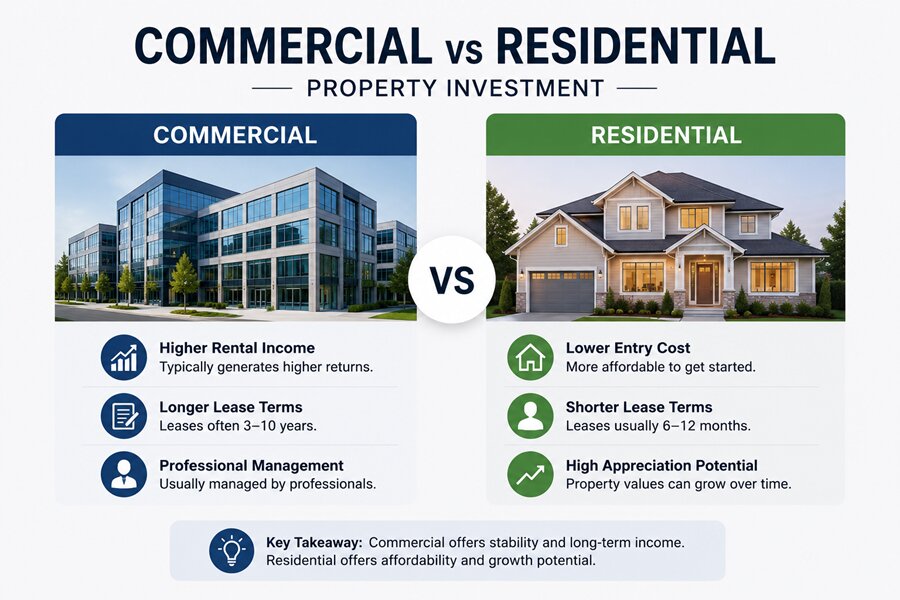
For most first-time investors, residential property offers lower risk, easier financing, and steady demand.
For investors seeking higher rental income and stronger cash flow, commercial property often delivers better rental yields but comes with higher investment requirements and vacancy risks.
The best investment depends on your budget, income goals, risk tolerance, and investment horizon.
Introduction
One of the most common questions Indian investors ask is the following:
“Should I invest in commercial property or residential property?”
The answer isn’t as simple as choosing the option with the highest returns.
Commercial and residential real estate serve different purposes, attract different tenants, generate different yields, and carry different risks.
A residential apartment in Bangaloremay appreciate steadily over time while generating moderate rental income. A commercial office space may produce significantly higher monthly rent but could remain vacant for months during economic downturns.
Understanding these differences is critical before investing lakhs—or even crores—of rupees.
This guide compares commercial and residential property investment across returns, risks, taxation, financing, appreciation potential, and long-term wealth creation.
What Is Residential Property Investment?
Residential property investment involves purchasing real estate intended for people to live in.
Examples include:
- Apartments
- Villas
- Independent houses
- Builder floors
- Row houses
- Gated community homes
Investors earn money through:
- Rental income
- Capital appreciation
- Long-term wealth accumulation
Residential properties remain the most popular investment choice among Indian investors because housing demand is relatively stable.
What Is Commercial Property Investment?
Commercial property investment involves purchasing properties used for business activities.
Examples include:
- Office spaces
- Retail shops
- Showrooms
- Business parks
- Warehouses
- Industrial properties
- Co-working spaces
Commercial investors primarily focus on:
- Higher rental yields
- Longer lease agreements
- Strong cash flow
Commercial real estate is often considered an income-generating asset rather than purely an appreciation asset.
Commercial vs Residential Property: Key Differences
| Factor | Residential Property | Commercial Property |
| Initial Investment | Lower | Higher |
| Rental Yield | 2%–5% | 6%–10%+ |
| Vacancy Risk | Lower | Higher |
| Tenant Duration | 11–24 months | 3–9 years |
| Financing Availability | Easier | More restrictive |
| Maintenance | Moderate | Higher |
| Liquidity | Better | Lower |
| Appreciation Potential | Strong in growth corridors | Location-dependent |
| Entry Barrier | Lower | Higher |
| Risk Level | Moderate | Higher |
Which Generates Better Rental Income?
Commercial property generally wins.
Residential Rental Yield
Typical yields in Indian cities:
- Bangalore: 2.5–4%
- Hyderabad: 2–4%
- Pune: 2–3.5%
- Mumbai: 2–3%
Example:
Property Value = ₹1 Crore
Annual Rent = ₹3 Lakhs
Yield = 3%
Commercial Rental Yield
Commercial assets often generate:
- 6%
- 7%
- 8%
- Even 10% in premium locations
Example:
Property Value = ₹1 Crore
Annual Rent = ₹8 Lakhs
Yield = 8%
Commercial rental income can be two to three times higher than residential income.
Which Has Better Capital Appreciation?
Residential properties often outperform commercial properties in appreciation over long periods.
Why?
Housing demand grows due to:
- Population growth
- Urbanization
- Infrastructure development
- Employment growth
- Mortgage accessibility
For example, many residential micro-markets in Bangalore have witnessed significant appreciation following metro expansion and IT corridor development.
Commercial properties appreciate too, but growth depends heavily on business demand and leasing activity.
Vacancy Risk Comparison
Residential Property
People always need homes.
Even during market slowdowns:
- Families continue renting
- Students continue renting
- Working professionals continue renting
Vacancy periods are usually shorter.
Commercial Property
Commercial spaces are vulnerable to:
- Economic recessions
- Corporate downsizing
- Business closures
- Remote work trends
A commercial property can remain vacant for several months if tenant demand weakens.
This is one of the biggest risks investors underestimate.
Financing and Home Loan Availability
Residential properties have a major advantage.
Banks typically provide:
- Higher loan-to-value ratios
- Lower interest rates
- Longer tenures
Commercial property loans often require:
- Larger down payments
- Higher interest rates
- Stronger income documentation
This makes residential property more accessible to first-time investors.
Tenant Stability
Commercial tenants usually stay longer.
Residential leases:
- 11 months
- 1–2 years
Commercial leases:
- 3 years
- 5 years
- 9 years
Long-term commercial leases create predictable income streams.
This is particularly attractive for investors seeking passive cash flow.
Maintenance and Operating Costs
Residential maintenance is generally simpler.
Typical expenses include:
- Society maintenance
- Repairs
- Painting
- Plumbing
Commercial properties may require:
- Common area maintenance
- Structural upgrades
- Tenant-specific modifications
- Property management services
Higher income often comes with higher maintenance responsibilities.
Tax Implications
Both investments have tax considerations.
Investors should evaluate:
- Rental income taxation
- Property tax
- GST implications
- Capital gains tax
- Depreciation benefits
Commercial assets may offer additional deductions depending on ownership structure and usage.
Consult a qualified tax professional before making investment decisions.

Which Is Better for First-Time Investors?
Residential property is usually better for beginners.
Reasons:
- Lower investment requirement
- Easier financing
- Stable demand
- Lower vacancy risk
- Simpler management
For investors purchasing their first real estate asset, residential property often provides a safer learning experience.
Which Is Better for Passive Income?
Commercial property often performs better.
Investors seeking:
- Monthly cash flow
- Rental income
- Yield-focused investing
often prefer commercial assets.
The higher yield can create stronger passive income compared to residential property.
Commercial vs Residential ROI Calculation
Step 1: Calculate Annual Rental Income
Monthly Rent × 12
Step 2: Calculate Net Annual Income
Annual Rent – Maintenance – Taxes – Vacancy Cost
Step 3: Calculate ROI
ROI = (Net Annual Income ÷ Property Cost) × 100
Example:
Property Cost = ₹1 Crore
Net Annual Income = ₹8 Lakhs
ROI = 8%
Investors should compare net ROI rather than gross rental income.
When Should You Choose Residential Property?
Residential property is ideal if:
✓ You are a first-time investor
✓ You want easier financing
✓ You prefer lower risk
✓ You seek long-term appreciation
✓ You plan future self-occupation
✓ You have limited capital
When Should You Choose Commercial Property?
Commercial property is ideal if:
✓ You want higher rental yield
✓ You seek stronger cash flow
✓ You have investment experience
✓ You can tolerate vacancies
✓ You have larger capital available
✓ Your focus is income generation
Conclusion:
There is no universal winner in the commercial vs residential property debate.
Choose residential property if your priorities are stability, easier financing, lower risk, and long-term appreciation.
Choose commercial property if your priorities are higher rental income, better yields, and stronger cash flow.
For many investors, the smartest strategy is to start with residential real estate and gradually diversify into commercial assets as capital and experience grow.
The best investment is the one aligned with your financial goals—not necessarily the one offering the highest headline returns.
Recommended references:
- National Housing Bank Housing Price Index Reports
- Reserve Bank of India Housing & Lending Data
- CREDAI Market Reports
- Knight Frank India India Real Estate Reports
- JLL India Office Market Reports
- CBRE India Investment Outlook Reports
FaQ:
Commercial property usually offers higher rental yields, while residential property generally provides lower risk and better financing options.
Commercial properties often generate higher rental ROI, while residential properties may offer stronger long-term appreciation.
Yes, especially in growing business districts with strong tenant demand and infrastructure development.
Residential properties have lower vacancy risk, easier loans, and consistent housing demand.
Commercial properties in India commonly generate 6%–10% rental yields depending on location and tenant quality.
Residential properties typically generate 2%–5% rental yields.
Residential property is generally considered safer due to stable demand and lower vacancy periods.
Yes, but residential property is usually more suitable because of lower capital requirements and simpler financing.
Residential property often experiences stronger appreciation in rapidly growing urban areas.
Investors focused on rental income may prefer commercial assets, while those seeking appreciation and lower risk often choose residential property.