
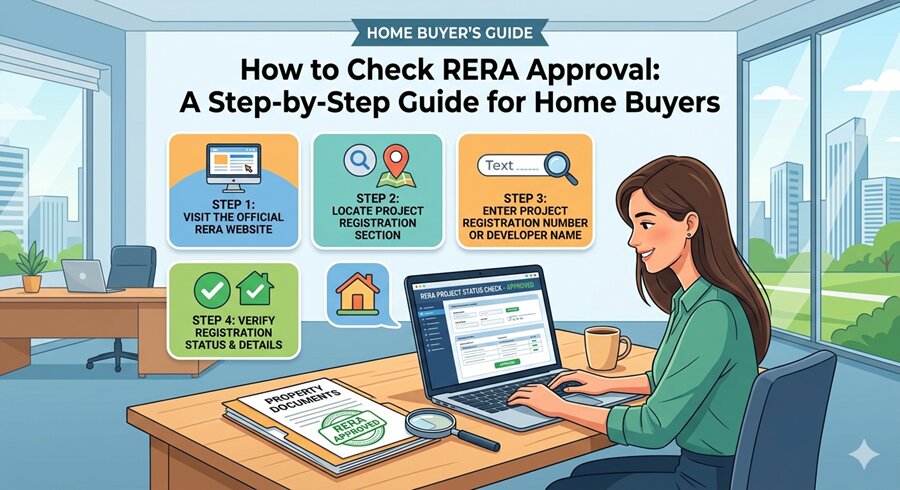
Buying a property in India is no longer just about location, pricing, and amenities. In 2026, smart homebuyers are focusing on legal verification before paying even a token amount. One of the most important checks today is verifying whether the property is registered under Real Estate Regulatory Authority (RERA).
If you are planning to buy an apartment, villa, plotted development, or invest in a pre-launch project, learning how to check RERA approval can protect you from project delays, hidden legal issues, and fraudulent builders.
This detailed guide explains:
- What RERA approval means
- How to check RERA approval online
- Which documents to verify
- Common mistakes buyers make
- Latest real estate trends and statistics
- SEO-friendly FAQs people search on Google
Whether you are a first-time homebuyer or a real estate investor, this article will help you make safer and smarter property decisions.
What is RERA Approval?
The Real Estate (Regulation and Development) Act, 2016 was introduced to improve transparency and accountability in the Indian real estate market.
Under RERA rules:
- Builders must register eligible projects
- Developers must disclose approvals and timelines
- Buyers get legal protection against delays and false promises
- Construction progress must be updated regularly
A RERA-approved project means the developer has registered the project with the respective state RERA authority and submitted key project information for public access.
Today, most reputed builders prominently display their RERA registration number in:
- Advertisements
- Websites
- Brochures
- Property listings
Why Checking RERA Approval is Important in 2026
India’s real estate market has grown rapidly in recent years, especially in cities like Bengaluru, Hyderabad, Pune, and Gurugram.
However, project delays and misleading marketing still remain major concerns.
According to UP-RERA data, project registrations increased from 197 projects in 2023 to 308 projects in 2025, reflecting rising demand for regulated and legally compliant developments. (Reference: ETReality)
Maharashtra alone crossed 50,000 RERA-registered projects, becoming the first Indian state to achieve this milestone. (Reference: Timesofindia)
At the same time, delayed possession cases continue to affect thousands of buyers across India.
This is exactly why RERA verification has become essential before buying any property.
Benefits of Buying a RERA Approved Property
1. Better Transparency
Builders must disclose:
- Land status
- Layout plans
- Government approvals
- Carpet area
- Project timelines
This reduces hidden risks for buyers.
2. Protection Against Delays
Under RERA, developers can face penalties or compensation claims if possession is delayed beyond the promised timeline.
3. Easier Due Diligence
The new Unified RERA portal launched in India is making project verification easier for homebuyers by centralizing project data and improving transparency.
4. Reduced Risk of Fraud
RERA registration helps buyers avoid:
- Fake projects
- Unauthorized layouts
- Illegal land transactions
- Misleading pre-launch advertisements
In fact, Telangana RERA recently warned developers against promoting unregistered pre-launch projects.
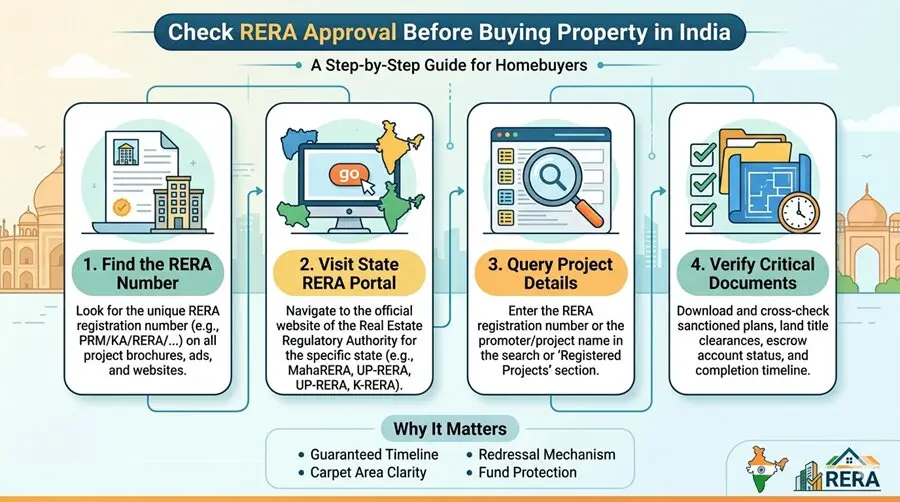
How to Check RERA Approval Before Buying Property
Here is the complete step-by-step process.
Step 1: Visit the Official State RERA Website
Every Indian state has its own RERA portal.
Examples include:
- Karnataka RERA
- MahaRERA
- UP RERA
- Telangana RERA
- Haryana RERA
Search queries commonly used on Google:
- “Check RERA approval online”
- “RERA approved projects list”
- “How to verify RERA registration”
- “Karnataka RERA project search”
Always use the official government website instead of third-party portals.
Step 2: Search by Project Name or Registration Number
Ask the builder for:
- RERA registration number
- Project registration certificate
Enter either:
- Project name
- Builder name
- Registration number
The portal should display complete project details.
If the project does not appear in search results, treat it as a warning sign.
Step 3: Verify Project Information Carefully
Most buyers only check whether a project is registered. Smart buyers verify the complete information.
Check:
- Project status
- Registration validity
- Possession timeline
- Number of approved units
- Development phase
- Project address
Also verify whether the project is:
- Active
- Completed
- Delayed
- Expired
- Revoked
Step 4: Review Builder Details
The RERA portal also provides builder information.
Check:
- Company name
- Office address
- Previous projects
- Litigation history
- Complaint records
This helps you understand the builder’s credibility.
Even if a project is RERA registered, buyers should still verify the developer’s past delivery record.
Many experienced buyers on real estate forums now emphasize that RERA registration alone should not be treated as a guarantee of quality or timely delivery.
Step 5: Check Legal Documents
A genuine RERA-approved project usually uploads important documents such as:
- Approved layout plans
- Land ownership records
- Environmental clearances
- Commencement certificates
- Quarterly construction updates
Do not skip document verification.
One of the biggest mistakes buyers make is assuming registration automatically confirms legal ownership.
Step 6: Verify Possession Timelines
Many property buyers ignore delivery timelines during booking.
RERA requires developers to mention:
- Construction deadlines
- Expected possession date
- Phase-wise completion schedule
If the project already has multiple deadline extensions, investigate carefully before investing.

What are the important documents to Check Before Buying Property
Besides RERA approval, verify the following documents:
Sale Deed: Confirms ownership transfer.
Encumbrance Certificate:Shows whether the property has legal dues or loans.
Occupancy Certificate (OC):Mandatory for ready-to-move properties.
Completion Certificate (CC):Confirms construction follows approved plans.
Khata Certificate:Important in cities like Bengaluru for property tax and legal verification.
Common Mistakes Homebuyers Make
Ignoring Legal Verification: Many buyers trust advertisements without checking approvals.
Buying Based Only on Discounts:
Extremely low prices may indicate:
- Approval issues
- Financial problems
- Delayed construction
Assuming RERA Means Zero Risk:
RERA improves transparency, but buyers should still verify:
- Builder history
- Financial stability
- Delivery track record
Not Checking Complaints:
Most RERA portals allow buyers to view complaints against developers.
Checking complaint history can help identify risky projects early.
How RERA Has Changed Indian Real Estate
Since its implementation, RERA has significantly improved transparency across India’s real estate sector.
According to industry reports:
- UP-RERA resolved disputes involving properties worth ₹5,943 crore across more than 11,000 cases. (Reference: ETReality)
- Over ₹2,126 crore has been transferred or settled for homebuyers in Uttar Pradesh alone. (Reference: ETReality)
- Project registrations and investments continue to rise due to increased buyer confidence.
This shows that buyers today prefer legally compliant and transparent projects.
Tips for Safe Property Investment in 2026
Before booking any property:
- Verify RERA registration
- Visit the project site physically
- Check builder reviews online
- Compare market prices
- Consult a legal expert
- Verify loan approvals from major banks
Banks such as:
- State Bank of India
- HDFC Bank
- ICICI Bank
usually conduct technical and legal verification before approving projects.
| State / UT | Official RERA Website |
|---|---|
| Central RERA Portal | RERA India Portal |
| Andhra Pradesh | AP RERA |
| Arunachal Pradesh | Arunachal Pradesh RERA |
| Assam | Assam RERA |
| Bihar | Bihar RERA |
| Chandigarh | Chandigarh RERA |
| Chhattisgarh | Chhattisgarh RERA |
| Delhi | Delhi RERA |
| Goa | Goa RERA |
| Gujarat | GujRERA Gujarat |
| Haryana | Haryana RERA |
| Himachal Pradesh | HP RERA |
| Jharkhand | Jharkhand RERA |
| Karnataka | Karnataka RERA |
| Kerala | Kerala RERA |
| Madhya Pradesh | MP RERA |
| Maharashtra | MahaRERA |
| Odisha | Odisha RERA |
| Punjab | Punjab RERA |
| Rajasthan | Rajasthan RERA |
| Tamil Nadu | Tamil Nadu RERA |
| Telangana | Telangana RERA |
| Uttar Pradesh | UP RERA |
| Uttarakhand | Uttarakhand RERA |
| West Bengal | WBHIRA West Bengal |
Conclusion:
Learning how to check RERA approval before buying property is one of the smartest steps a homebuyer can take in 2026.
The Indian real estate market is becoming more transparent, but buyers still need to perform proper due diligence before investing.
A few hours spent verifying:
- Legal approvals
- Builder credibility
- Project timelines
- Complaint history
can save years of financial stress later.
Whether you are buying your first apartment or investing in premium real estate, always choose transparency over marketing promises.
Frequently Asked Questions:
RERA approval means a real estate project is registered under the Real Estate Regulatory Authority (RERA) established under the Real Estate (Regulation and Development) Act, 2016. A RERA-approved project must disclose legal approvals, project timelines, builder information, carpet area details, and construction updates to improve transparency and protect homebuyers from fraud or project delays.
RERA approval means a real estate project is registered under the Real Estate Regulatory Authority (RERA) established under the Real Estate (Regulation and Development) Act, 2016. A RERA-approved project must disclose legal approvals, project timelines, builder information, carpet area details, and construction updates to improve transparency and protect homebuyers from fraud or project delays.
You can check RERA approval online by visiting your state’s official RERA website and searching using the project name, builder name, or RERA registration number. The portal will display project status, approvals, builder details, possession timelines, legal documents, and complaint history.
To verify whether a project is RERA registered:
- Visit the official state RERA portal
- Enter the project name or registration number
- Check project status and registration validity
- Review uploaded approvals and legal documents
If the project does not appear on the official portal, it may not be legally registered under RERA.
RERA registration is mandatory for most residential and commercial real estate projects that exceed the prescribed land or unit limit defined by state authorities. Small projects may be exempt, but buyers should always verify legal approvals before investing.
If a builder launches or sells a project without mandatory RERA registration, buyers may face risks such as:
- Legal disputes
- Construction delays
- Missing approvals
- Lack of buyer protection
- Difficulty in filing complaints
Many states can impose penalties on developers for violating RERA regulations.
RERA approval improves transparency and buyer protection, but buyers should still perform independent verification. Before booking a property, check:
- Builder reputation
- Land ownership
- Financial stability
- Previous project history
- Construction quality
- Bank approvals
RERA registration reduces risk but does not guarantee zero delays or perfect execution.
You can ask the builder for the project’s RERA registration number. Then visit the official state RERA portal and search using that number to verify:
- Project authenticity
- Registration validity
- Completion timeline
- Legal approvals
- Developer details
Most genuine builders also display the RERA number in advertisements and brochures.
Apart from RERA registration, buyers should verify:
- Sale deed
- Encumbrance certificate
- Occupancy certificate (OC)
- Completion certificate (CC)
- Approved building plan
- Land ownership documents
- Khata certificate
- Property tax receipts
Proper legal verification helps avoid future disputes.
Most state RERA websites have complaint and order sections where buyers can view:
- Cases filed against builders
- Pending disputes
- Penalty orders
- Project delay complaints
- Consumer grievances
Checking complaint history can help identify risky developers before investing.
To verify whether a property is legally approved:
- Check RERA registration
- Verify land ownership
- Review approved layout plans
- Confirm municipal approvals
- Check environmental clearances
- Verify occupancy and completion certificates
Consulting a real estate lawyer is also recommended for high-value property purchases.
Buying a pre-launch project without RERA approval can be risky because approvals may still be pending. Buyers may face:
- Construction delays
- Legal issues
- Project cancellation
- Financial losses
Always verify whether the project has received official RERA registration before making payments.
The official RERA portal displays the expected completion and possession timeline submitted by the developer. Buyers should compare:
- Original promised date
- Current construction status
- Extension approvals
- Delay history
Projects with repeated extensions should be evaluated carefully.
Yes, RERA provides legal protection to buyers against unreasonable project delays. In many cases, buyers may:
- File complaints
- Seek compensation
- Request refunds
- Claim interest for delayed possession
However, dispute resolution timelines may vary across states.
Buyers should verify:
- Mother deed
- Sale deed
- Encumbrance certificate
- Land conversion approvals
- Tax receipts
A property lawyer can help confirm whether the builder has clear legal ownership and development rights.
Yes, even RERA-approved projects can face delays due to:
- Financial issues
- Approval delays
- Construction challenges
- Market conditions
- Legal disputes
However, RERA gives buyers better legal remedies and transparency compared to unregistered projects.
The best source is the official state RERA website for your location, such as:
- Karnataka RERA
- MahaRERA
- Telangana RERA
- Haryana RERA
- UP RERA
Avoid relying only on third-party listing websites for legal verification.
Banks usually conduct technical and legal due diligence before approving loans for a project. They verify:
- RERA registration
- Land ownership
- Government approvals
- Construction progress
- Legal compliance
Projects approved by major banks often have stronger credibility, but buyers should still verify independently.
RERA registration focuses on project transparency and buyer protection, while municipal approvals relate to:
- Building permissions
- Layout sanctions
- Zoning compliance
- Infrastructure approvals
A legally compliant project usually requires both RERA registration and municipal approvals.
Yes, buyers can file complaints with the respective state RERA authority for issues such as:
- Delay in possession
- False advertising
- Structural defects
- Hidden charges
- Violation of agreements
Most state RERA portals offer online complaint filing systems.
To reduce risk:
- Verify RERA registration
- Check legal documents
- Research builder history
- Visit the project site
- Confirm approvals from authorities
- Avoid cash transactions
- Consult legal experts before signing agreements
Proper due diligence is the most effective way to avoid property fraud in India.